3D modeling a building is tedious. The software takes time to learn, and the design can change before the model is finished. Keeping up becomes an endless cycle of revisions that eats into your team’s time.
I studied architecture. I care about what a building looks like and how a space feels. I want to try a different idea or see whether a form works. I’d happily hand over the work of constructing and adjusting the geometry.
With frontier AI models like GPT-6 Astra, that is becoming practical. They can reason about how parts relate to one another in an image and use tools to act on that reasoning. Give them a modeling environment, and you can ask them to build something, inspect it, and make changes.
We’ve been doing this with Astra in the Codex desktop app, with Modelcore open in its browser. I supply references for a building and ask the agent to create a schematic model. Once the building is there, I start picking out details I want to change. The chat becomes a way to edit the 3D model directly.
One request was to add linework to the roof to emulate boards and ensure the covered entry was sheathed in plywood.
Astra added the roof lines and the plywood lining to the existing model in seconds. I could inspect the result and decide what to do next without modeling those details myself.
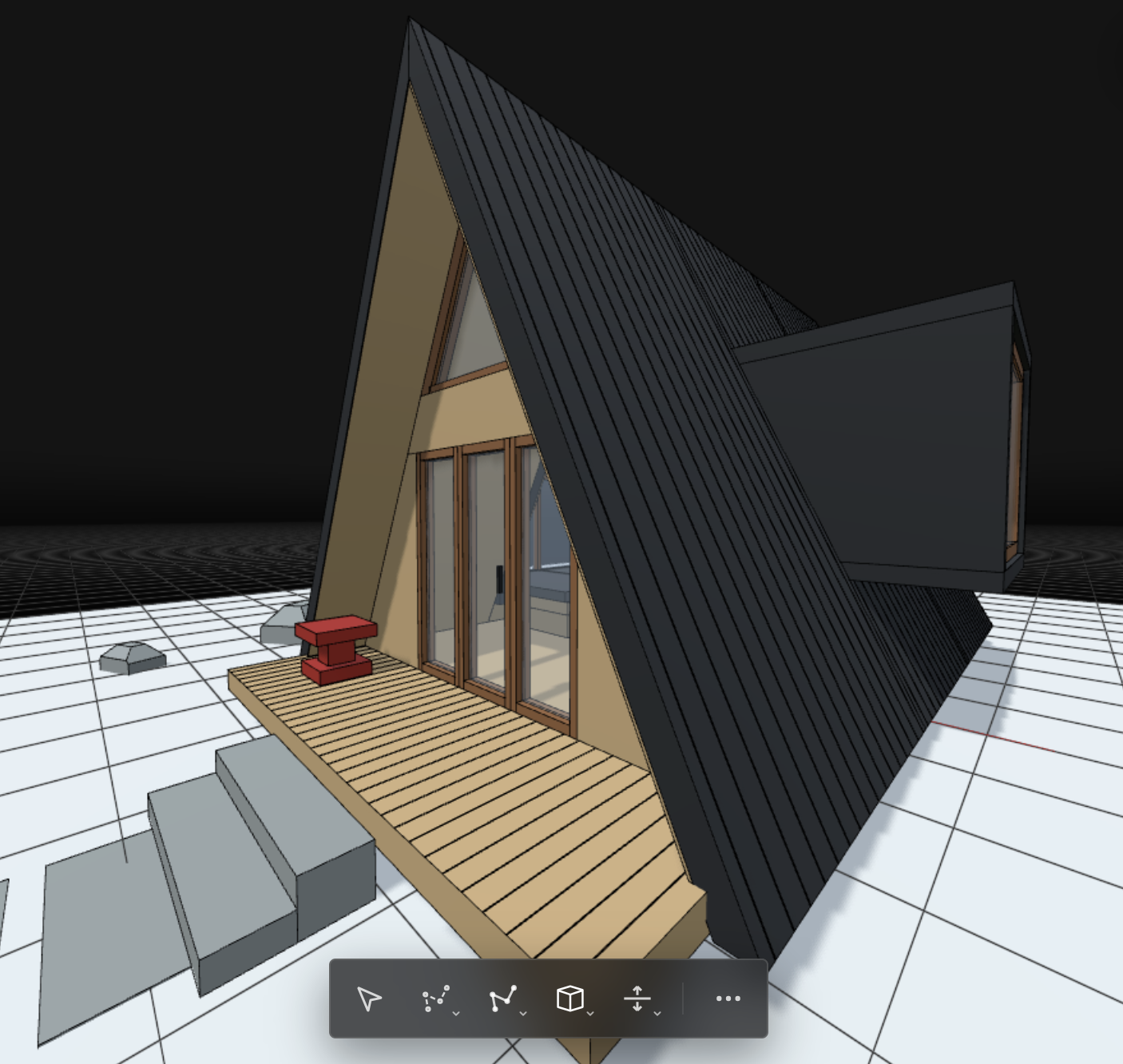
That’s how I want 3D modeling to work. I should be able to put my attention into the design and have the software carry out the edits.
To build from plans and photos, the agent has to connect the different views and work out how they describe the same building. It then has to relate those references to the geometry in Modelcore. For the plywood request, it had to identify the surfaces that formed the covered entry.
That is spatial reasoning in practice: understanding the building’s parts and their relationships well enough to plan an edit. GPT-6 Astra is the example we used here, but the capability is developing across frontier models. Google describes similar progress in spatial reasoning and computer use in Gemini.
I’m building Modelcore to put the next advances in spatial reasoning to work. My bet is that within six months, we could do much of this work without touching a CAD interface. Within eighteen months, we could be producing detailed building information models (BIM) as quickly as we revise the design.
Getting there requires modeling tools that let an agent turn a plan into geometry and examine the result before continuing. Modelcore supplies those operations and keeps the project available for me to review in the browser.
We make those tools accessible through WebMCP, an emerging browser capability that lets web applications expose structured tools to AI agents. The agent uses them to work on the same project I can see and edit. The modeling itself happens in Modelcore.
In the cabin test, we used named assemblies and reusable component instances. The roof lines had a nominal spacing of 200 mm, so we could check their positions and where they ended around openings. We could also inspect whether the plywood covered the intended area and met the surrounding surfaces.
Those details matter because I want to keep working on the model. After adding the roof lines, I might want to change their spacing. Organized, editable geometry gives the next request something specific to act on.
This is why I’m developing the system in Modelcore. Because we build the modeling technology, we can improve an operation for both the agent carrying it out and the person reviewing the result. If an edit is awkward, we can change how the modeling system handles it.
Blender has a Python API and Geometry Nodes for extensive automation. But connecting an agent to Blender would still leave us with the job of designing the architectural workflow around it: how building parts are organized, how edits are checked, and how a person takes over.
Modelcore already gives us a browser-based solid modeling environment where people can work on a project together. Developing the automation there lets us improve the same product for manual and agent-driven work. As the AI models improve, we can put their reasoning to work through those tools.
That changes which ideas I’m willing to try. If I have to construct every variation myself, the modeling effort becomes part of the decision. When I can ask for a revision and inspect it, I have more room to explore the design.
The checks belong in that process too. I want the system to verify that parts meet and spacing is correct, then leave me with a saved project I can reopen. Automating the modeling means taking on that work as well.
I see the future of 3D modeling in this exchange: bring an idea, have the software build it, and keep revising it as you work out what you want. Astra demonstrates it today, and I’m building Modelcore to make better use of each advance in the models.